Updated: 12/28/2015
The United States Securities and Exchange Commission (the “SEC”) adopted revisions to Regulation AB on August 27, 2014, after a four year process of proposals and review. Regulation AB is the rule that governs the offering disclosure and periodic reporting obligations of issuers of asset-backed securities (“ABS”).
Insofar as covered bonds are concerned, several things are clear. First, covered bonds are not included in the definition of “asset-backed security.” Item 1101 of Regulation AB provides that:
Asset-backed security means a security that is primarily serviced by the cash flows of a discrete pool of receivables or other financial assets, either fixed or revolving, that by their terms convert into cash within a finite time period, plus any rights or other assets designed to assure the servicing or timely distributions of proceeds to the security holders; provided that in the case of financial assets that are leases, those assets may convert to cash partially by the cash proceeds from the disposition of the physical property underlying such leases.
It is clear that covered bonds are not “primarily serviced by the cash flows of a discrete pool of receivables or other financial assets.” Instead, covered bonds are senior obligations of the issuing financial institution and are expected to be repaid from the general funds of the institution. Accordingly, covered bonds should not be asset-backed securities and Regulation AB should not apply generally to covered bonds.
Use CBs to Restart the PLS Market
In the United States there is a lot of discussion about how to reduce the taxpayers’ exposure to housing finance. The conservatorships of Fannie Mae and Freddie Mac were a pointed reminder of the extent of the government’s, and the taxpayers’, role in housing finance. Additionally, after being taken into conservatorship, the GSEs were intentionally used to prevent a feared collapse of the housing market, further expanding their role.
As a result, the GSEs, together with FHA and GNMA, at one point provided more than 95% of the financing for new residential mortgage loans, and today they still finance roughly nine out of every ten new mortgage loans. At the same time, the private label securities (PLS) market, which provided significant private funding for residential mortgage loans, essentially vanished. The issuance of new PLS declined nearly 99% in the years following the crisis.
Today there is general agreement across the political spectrum that it would be desirable to restore some level of private funding for residential mortgage loans and reduce the role of the GSEs. There are also plans to reform the GSEs and refine their mission in housing finance. There is less agreement on the reform proposals.
On June 27, 2014, Treasury Secretary Jacob Lew requested comment on what steps could be take to restore a functioning PLS market. Almost uniformly the commenters voiced the need to shrink the presence of Fannie and Freddie in the market in order to make room for a PLS market. This reflected the view that under the existing authority of the GSEs, the private market would not be price competitive and would only be able to finance a small number of loans that did not qualify for financing through the GSEs under their very high loan limits.
However, the presence of the GSEs is not the only factor impeding the development of the PLS market. The regulatory landscape for securitizing mortgage loans has been altered dramatically since the crisis. Basel III imposes heavy, in some cases almost punitive, increased capital requirements on banks and most particularly for securitization exposures held by banks. The risk weighting for securitization exposures can range up to 1250% and in some cases, such as non-cash gain on sale, the capital requirements will result in a deduction from Tier 1 equity capital. Rulemaking by the Consumer Financial Protection Board exposes any holder of a mortgage loans to severe penalties for those loans not underwritten in accordance with the CFPB underwriting criteria, which are designed to protect the borrower. SEC requirements for mortgage securitization require 270 data points of information to be disclosed for every mortgage loan in a securitization, both at the time of the offering and in periodic reporting for the life of the securitization. Then there is risk retention, prohibited conflicts of interest, margin requirements for swaps, the Volcker Rule, conflicting requirements in foreign securities markets and a litany of other burdens on the PLS market.
SEC Finalizes Reg AB II
On Wednesday, August 27, 2014, the United States Securities and Exchange Commission finalized the changes to Regulation AB (commonly referred to as Reg AB II). The Commission issued a press release and a draft adopting release adopting the changes. The final version of the adopting release will be published in the Federal Register after review by the Office of Management and Budget (OMB). Regulation AB II and the related changes regulate the offering process and the disclosure and reporting requirements for asset-backed securities. Perhaps the most significant changes are (i) a requirement to file a preliminary prospectus at least three days prior to the sale of any securities and (ii) disclosure of loan-level information in machine readable form for ABS backed by residential mortgage loans, commercial mortgage loans, auto loans, auto leases, and debt securities (including resecuritizations). Updated loan-level data also must be filed periodically after issuance of the securities. The loan-level disclosure requirements come into force not later than two years after the effective date of the changes, which will be the date of the publication of the changes in the Federal Register.
The effect on covered bond issuers of these changes is still being analyzed and will be covered by a later post. However, it is clear that these changes would not be directly applicable to Rule 144A offerings of covered bonds.
SEC Calls Reg AB II Meeting
The SEC announced today that it would hold a public meeting to consider amendments to Regulation AB on Wednesday, August 27:
SECURITIES AND EXCHANGE COMMISSION
Sunshine Act Meeting.
Notice is hereby given, pursuant to the provisions of the Government in the Sunshine Act, Pub. L. 94-409, that the Securities and Exchange Commission will hold an Open Meeting on Wednesday, August 27, 2014 at 10:00 a.m., in the Auditorium, Room L-002.
The subject matters of the Open Meeting will be:
- The Commission will consider whether to adopt rules revising the disclosure, reporting and offering process for asset-backed securities. The revisions would require asset-backed issuers to provide enhanced disclosures, including information for certain asset classes about each asset in the underlying pool in a standardized, tagged format, and revise the shelf offering process and eligibility criteria for asset-backed securities.
- The Commission will consider whether to adopt rule amendments and new rules to implement provisions of the Dodd-Frank Wall Street Reform and Consumer Protection Act concerning nationally recognized statistical rating organizations, providers of third-party due diligence services for asset-backed securities, and issuers and underwriters of asset-backed securities under the Securities Exchange Act of 1934.
The duty officer has determined that no earlier notice was practicable.
At times, changes in Commission priorities require alterations in the scheduling of meeting items.
For further information and to ascertain what, if any, matters have been added, deleted, or postponed, please contact:
The Office of the Secretary at (202) 551-5400.
Kevin M. O’Neill
Deputy Secretary
Dated: August 22, 2014
http://www.sec.gov/news/openmeetings/2014/ssamtg082714.htm
Although the SEC’s proposal to amend Regulation AB (hence Reg AB II) is primarily concerned with asset-backed securities, the Commission’s action will be of interest to covered bonds issuers for two reasons:
- whether covered bonds will be defined as asset-backed securities and therefore expressly subject to Reg AB II;
- whether Reg AB II requirements will be extended to asset-backed securities sold under Rule 144A.
Covered bonds do not fall within the current definition of asset-backed security, as the SEC has recognized in several no-action letter issued to Canadian banks. Nevertheless, in those no-action letters, the SEC has required the banks to comply with specific provisions of current Regulation AB as a condition of registering covered bonds with the SEC. If those provisions are amended, the banks could be required to comply with the provisions as amended.
However, if covered bonds are defined as asset-backed securities under Reg AB II, there may be other provisions that they would be required to comply with, including possibly the proposed requirement to issue a preliminary prospectus at least five days prior to the sale of any security.
Until now, Regulation AB has applied only to asset-backed securities registered with the SEC, and 144A covered bonds have not been subject to the regulation. The extension of Reg AB II to asset-backed securities offered under Rule 144A would therefore affect Rule 144A covered bonds if covered bonds were defined to be asset-backed securities. The extension of Reg AB II to privately placed securities sold under Rule 144A would be a major departure from prior practice. If Reg AB II is not extended to 144A securities, covered bonds could still be offered in the United States under Rule 144A without complying with Reg AB II, even if covered bonds were defined as asset-backed securities under Reg AB II.
Accordingly, the outcome of the meeting on Wednesday will be of considerable interest to covered bond issuers who currently offer or plan to offer covered bonds in the United States.
BNS Files U.S. Prospectus
BNS initially filed its registration statement for its legislative covered bond program on Form F-3 with the SEC on May 31, 2013. That registration was declared effective on September 9, 2013. However, BNS did not file a prospectus under the registration statement with the SEC until today, August 20, 2014. In the interim, BNS filed a prospectus with the UKLA and offered covered bonds in Europe on March 26, 2014. Now, with the filing of a prospectus with the SEC, BNS is ready to offer covered bonds in the U.S.
Year to date, the U.S. covered bond market has been very quiet. Only two issuers have brought bonds to market for a total of $3 billion: Westpac Banking Corp. on May 14 and Commonwealth Bank of Australia on June 14, both privately placed offerings. So far, no registered covered bonds have been issued in the U.S. in 2014.
Comment Letter to Treasury on Restoring PLS Market
On August 8, Morrison & Foerster LLP filed a comment letter with the United States Department of the Treasury in response to a request for comments on the private sector development of a well-functioning private label securities (PLS) market for residential mortgage loans. The comment letter notes that perhaps the easiest way to restore private funding to residential mortgage loans in the United States is to implement a covered bond statute in the United States to enable U.S. banks to issue covered bonds. The letter notes that the conditions necessary to the establishment of a covered bod market in the United States are well advanced and that the market could be established quickly. Based on the development of the investor base in the United States, the SEC’s establishment of disclosure and reporting standards, and the well-developed legislation, creation of a domestic covered bond market would appear to be low hanging fruit that Treasury should take advantage of.
Moody’s expects lower predictability of government support for Canadian banks; changes banking system outlook to negative
On July 8, Moody’s followed up on its June 11 announcement regarding risk related to a “bail-in” regime in Canada with an announcement of the change to “outlook negative” in Global Credit Research. Additionally, Moody’s notes that “high household indebtedness and elevated housing prices remain key risks to banking system stability in Canada”. Further, Moody’s states that “growth sought by the banks has led them to diversify into riskier businesses and geographies which dilute their strong domestic credit profiles and represent a growing risk to the Canadian system’s stability”.
EBA report on favorable capital treatment
On July 1, 2014, the European Banking Authority published a favorable opinion on the preferential capital treatment of covered bonds. The EBA also delivered a companion report entitled EBA Report on EU Covered Bond Frameworks and Capital Treatment. See also the press release from the EBA. The EBA concluded that the favorable capital treatment under the capital requirements regulation (CRR) for bank investments in covered bonds was appropriate, but called for some “further qualifying criteria for their preferential treatment.” The EBA recommended against the use of aircraft liens, residential mortgage backed securities (RMBS) and commercial mortgage backed securities (CMBS) as cover pool assets after December 2017. The opinion and the report were delivered to the European Commission in response to a request for advice.
With respect to favorable capital treatment the EBA said:
“Due to the good historical default/loss performance of covered bonds in the EU, the dual recourse principle embedded in covered bond frameworks whereby the covered bond holder has a claim on the issuing institution and a priority claim on the cover assets, the special public supervision for the protection of the bondholders mandated by the UCITS Directive and the existence of qualifying criteria in Article 129 of the CRR, the EBA considers the preferential risk weight treatment laid down in Article 129 of the CRR to be, in principle, an appropriate prudential treatment. “
Treasury trying to encourage private funding
Speaking in Washington on June 26 before the Making Homes Affordable Five Year Anniversary Summit, U.S. Secretary of the Treasury, Jacob Lew, gave a speech in which he addressed the need for housing finance reform. He also noted almost a complete absence of a private label securities market almost six years after the crisis and a need to restore private funding to the residential mortgage market. He noted that a series of questions was posted to the Treasury website seeking comment by August 8, 2014 on recommendations for reviving the private label securities market.
Neither Secretary Lew’s speech nor the posted questions mention covered bonds. Clearly covered bond legislation for the United States should be considered by the Treasury. The legislation introduced in 2011 by Representative Garrett, H.R. 940, passed the House Financial Services Committee by a very strong bi-partisan vote of 44-7. Passage of covered bond legislation should be easily achievable with Treasury backing and covered bonds could provide an important channel of private funding for the mortgage market. After all, covered bonds provide funding for about €3 trillion in the European market and the domestic U.S. market for covered bonds issued by foreign has shown healthy growth.
Moody’s: Canadian Banks on Outlook Negative
On June 11, 2014, Moody’s Investors Service changed the outlook of the seven largest Canadian banks from stable to negative and confirmed each of their long-term ratings. Moody’s stated that the action was taken in response to previously announced plans of the Canadian government to implement a “bail-in” regime for Canada. In Moody’s view, the balance of risks for senior debt holders and uninsured depositors of Canadian banks “has shifted to the downside.”
This rating action by Moddy’s has not affected the rating of any outstanding covered bonds issued by the banks. The current long-term ratings of the banks by Moody’s range from Aa3 to Aa1.
Johnson-Crapo Amendment to S. 1217
On Sunday, March 16, 2014, the Senate Banking Committee released a draft of an Amendment to S. 1217, which is the housing finance reform bill introduced last year by Committee members Mark Warner (D-VA) and Bob Corker (R-TN) to shut down FNMA and FHLMC and establish a new federal role for housing finance. The amendment released by the Committee is authored by Committee Chairman Timothy Johnson (D-SD) and Ranking Member Michael Crapo (R-ID). The amendment is introduced following a series of hearings held by the Committee last fall on S. 1217. Most significantly, the amendment continues to provide for the establishment of the Federal Mortgage Insurance Corporation and the elimination of FNMA and FHLMC.
The general view is that S. 1217 is likely to be the basis of any bill adopted to reform housing finance. Unfortunately for covered bonds, there is nothing in the amendment, and nothing in the original bill, to establish a statutory covered bond regime in the United States. Accordingly, any hope for including covered bond provisions in the bill apparently rests with the House including such provisions in any final bill through the conference committee process.
However, a strong majority of those present at a panel on housing finance reform at the SFIG conference this year in Las Vegas do not expect housing reform legislation to be enacted before 2017. The best prospects then for covered bond legislation in the near future probably lie elsewhere.
Another View on Canadian Housing
The Financial Times reports that “Pimco goes bearish on Canada” (Pimco goes bearish on Canada, FT, p. 16, March 3, 2014). The article reported that the Pimco Total Return Fund had reduced its holdings of Canadian debt by about 50% due to its concerns about housing prices in Canada. Pimco is reported to be expecting a decline in housing activity and prices this year due to tightening of mortgage credit and an increase in loan rates. The decline in prices is expected to be as much as 30% over the next two to five years, so a gradual decline over several years rather than an abrupt market fall. Other reports express a concern about the high levels of consumer indebtedness in Canada and the rapid rise in housing prices.
SEC Request for Comment on Asset-Level Information
On February 25, 2014, the SEC requested comment on a new proposal for disclosing asset-level information in connection with asset-backed securities. This is a reopening of a request for comment originally made in 2010 in connection with the proposal for amending Regulation AB. Under the new disclosure proposal, the issuer of ABS would disclose asset-level information on its website rather than submitting such information to the SEC for disclosure through the SEC’s EDGAR system. This new proposal was made in response to comments on the original proposal that raised significant privacy concerns.
The SEC proposes that issuers could restrict access to asset-level information only to investors in the related ABS and could require investors to certify that they would not “reverse engineer” downloaded data.
Under existing registration statements, the SEC does not require covered bond issuers to make asset-level information available. The no-action relief granted to Canadian covered bond issuers (see, e.g., the RBC letter) recognizes that covered bonds are not ABS, but nevertheless require disclosures regarding the cover pool assets consistent with ABS disclosure required under Regulation AB. The SEC has not committed to continue to take that position after the adoption of the amendments to Regulation AB. Accordingly, covered bond issuers who issue into the U.S. have been waiting see whether the new Regulation AB (Reg AB II) would require disclosure of asset-level information for covered bonds. This request for comment does not shed any light on that question.
The Case for U.S. Covered Bonds
Updated: 5/18/2015

Two U.S. banks issued covered bonds in 2006 and 2007. No U.S. banks have issued covered bonds since, due in part to the complexity of issuing structure used by U.S. banks. Legislation to implement covered bonds in the U.S. would change this. The benefits of covered bonds to both the issuing bank and to investors is set out below. These benefits would seem to provide a strong rationale for passing covered bond legislation.
The covered bond market in Europe is about $3 trillion of outstanding bonds. This suggests that covered bonds could provide a significant funding instrument for banks in the U.S. While no one expects covered bonds to provide all of the funding for residential mortgage loans in the U.S., given the historic role of the federal government in the market, covered bonds could be a significant factor. The combination of covered bonds, RMBS, FHLB loans and GNMA/FNMA/FHLMC would provide banks with improved diversity of funding.
What are covered bonds?

Covered bonds are senior, secured debt of a regulated financial institution. As in typical secured debt, if the issuing bank defaults, the collateral is used to cover any shortfall in payments due by the bank on the covered bonds. With covered bonds there is the added feature that, so long as there is sufficient collateral, the covered bonds are not accelerated, but rather paid on their scheduled payment dates. If the collateral at any time is inadequate to make all scheduled payments on the covered bonds, all outstanding covered bonds are accelerated and paid pro rata from the proceeds of the collateral in the same manner as typical secured debt. For a detailed description of covered bonds, see Covered Bonds Handbook available from the Practicing Law Institute. See also the Covered Bond website at Mayer Brown LLP.
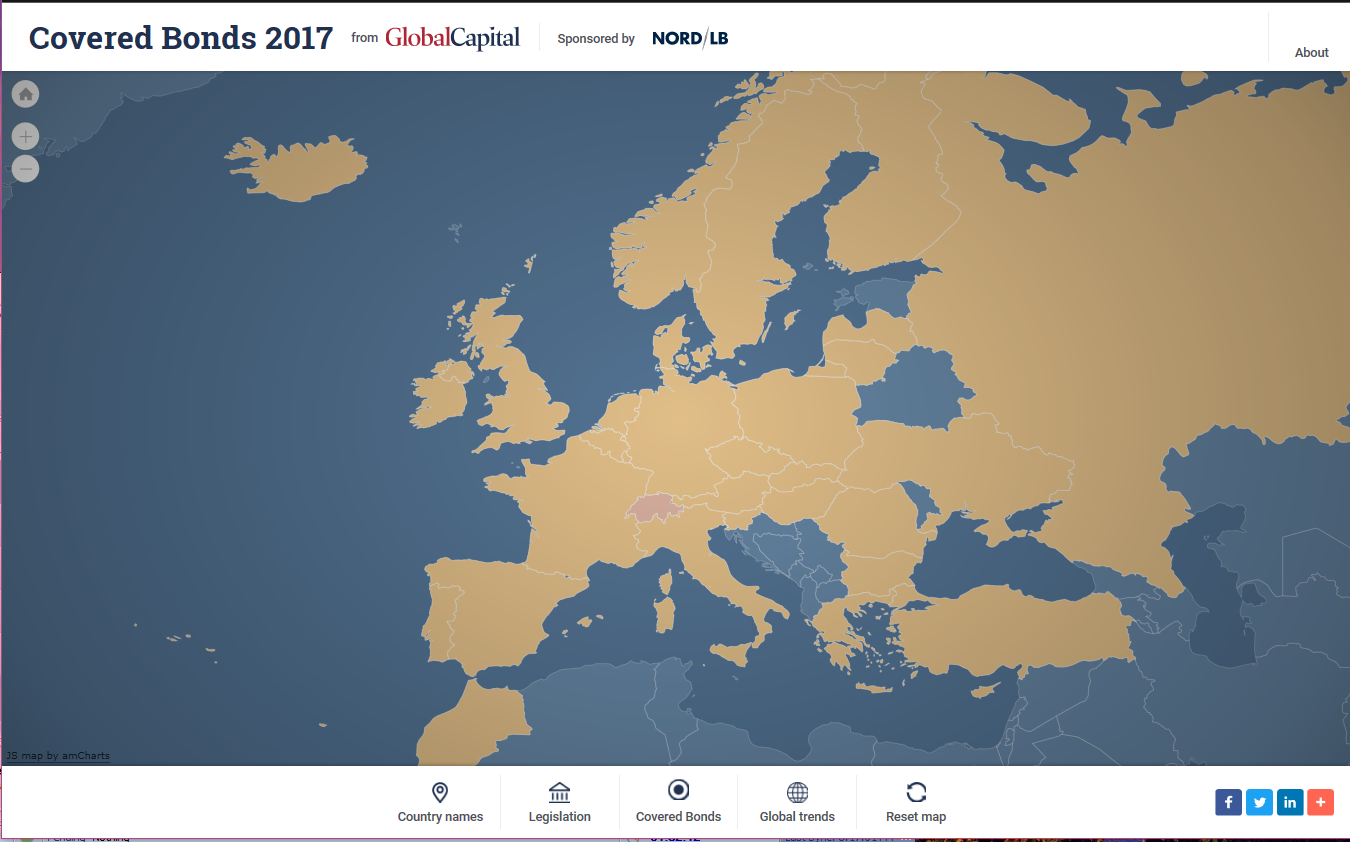
Covered bonds come in differed forms, depending on the jurisdiction of the issuer. In some jurisdictions, such as Germany, the collateral is held by the issuing bank and is isolated on its balance sheet and pledged to support the bonds. In other jurisdictions, such as the U.K., the collateral is transferred to a subsidiary of the issuing bank and the subsidiary guarantees bonds issued by the bank and secures the guarantee with the collateral. (See the accompanying map of the covered bond market, provided by Global Capital, for a list of jurisdictions with covered bonds.) The subsidiary, in effect, is only a security device to hold the collateral separate from the issuing bank in case of its insolvency. This two-tier arrangement is necessary in jurisdictions that do not have a special statute for covered bonds.
The collateral and any related interest rate and currency swaps are referred to as the “cover pool.” For the protection of investors, the adequacy of the assets in the cover pool to pay the covered bonds as scheduled is tested monthly. If the test is not passed, additional collateral must be added to the cover pool by the issuer.
Most often the collateral consists of residential mortgage loans, but some jurisdictions permit commercial mortgage loans, ship mortgage loans, and obligations of public sector entities.
In the single tier form, it is clear that the collateral continues to be owned by the issuing bank and is simply pledged to support the bonds. In the two-tier structure, the collateral is transferred to the subsidiary, but the bank continues to have an economic interest in the performance of the collateral. The collateral held by the subsidiary will be consolidated back onto the balance sheet of the issuing bank and losses on the collateral will be losses, on a consolidated basis, for the bank. Thus the bank continues to own the collateral as an indirect owner.

Covered bonds, then, are dual recourse instruments – the holder will look first to the bank for payment and, if the bank is unable to pay, the investor will look to the collateral. Thus the creditworthiness of the bank is of primary concern to investors and the collateral is of secondary concern. See the slides presented at ASF 2014 for more detail on structure.
Investor diversity.
The investors who purchase covered bonds typically purchase sovereign debt and agency debt. They do not typically purchase corporate bonds or ABS securities. These investors seek investments with low risk of principal acceleration due to issuer default or insolvency. The certainty of payment at, but not before, maturity is an important feature. Accordingly, this is a class of investors that an issuing bank does not reach except by issuing covered bonds, providing important diversity of funding for the issuing bank.
The investor base is comprised primarily of banks, central banks and investment funds. Banks and central banks together are often 50% to 70% of the investor base of an offering.
Excellent funding rates.
This conservative class of investors is seeking a return that exceeds that of sovereign or agency debt, but with a similar risk profile. This permits the issuing bank to fund itself with covered bonds at very attractive rates. In fact, other than in times of severe turmoil, covered bonds are viewed as a ‘rates’ product and not a ‘credit’ product, similar to sovereign and agency debt.
For example, TD Bank in 2012 issued $3 billion of 5 year covered bonds at mid-swaps plus 45. RBC in 2013 issued $2 billion of 5 year covered bonds at mid-swaps plus 43. This is very attractive funding. BNS in 2014 issued €1.250 billiion of three year covered bonds at mid-swaps minus 4.
Transparent to regulators.
From a regulator’s perspective, a bank’s exposure on its covered bonds is simpler to analyze than its securitization exposure. As the numerous recent litigation settlements by banks has shown, securitization exposes banks to the risk of significant cost that is not apparent in the financial statements or other disclosures of the banks. JPMorgan, for example, in a single settlement with the Justice department and various State attorneys general, recently settled one set of claims for $12 billion. The aggregate settlement amount to date in the U.S. for the banking industry in early 2014 was estimated to be around $100 billion and there is more to come. This exposure was not apparent to regulators pre-crisis. Securitization had been viewed by banks and regulators as a transfer of risk of the assets to investors, relieving the banks of exposure to the assets.
Covered bonds do not present this hidden risk to regulators because the assets in the cover pool remain on the balance sheet of the issuing institution. The nature and performance of the assets is a constant audit and financial reporting item, readily apparent to the supervising agencies. Because the issuing institution retains 100% of the risk on the assets, it has a strong incentive to monitor and maintain high origination standards. This incentive tends to align the interests of the banks and the regulators in a way that securitization never will.
Friendly to borrowers.
Covered bonds are friendlier to borrowers than securitization. In a securitization, loans are sold to a securitization vehicle; the selling bank ceases to be a contractual party to the loans. As a consequence, the securitization entity acquires the right to make any and all decisions with respect to granting payment rescheduling or other relief to a borrower in financial difficulty or foreclosing on property securing a loan. Securitization entities are bound typically by a trust agreement or pooling agreement that spells out all actions the entities may take with respect to the loans. These provisions generally do not provide for discretion to be exercised by the securitization entities to work with borrowers to avoid default and foreclosure.
The transfer of a loan to the securitization entity means that a borrower can no longer discuss with his lender alternatives that the lender might offer to avoid default. The lender no longer has the power to effect any relief for a deserving borrower. That power has been transferred to a securitization entity and the securitization entity is typically bound by agreements not to provide such relief.
Additionally the borrower often has difficulty determining who may have some ability to grant relief. The borrower’s loan may have been transferred through several entities before reaching the securitization entity. And securitization entities do not have employees. All actions of securitization entities are performed under contract by third parties including trustees and loan servicers. Consequently, even identifying the party that may have the power to grant relief can be hard. And if identified, locating the appropriate person at the third party can be yet another difficult task for a borrower.
Covered bonds do not create this obfuscation. Each loan continues to be owned by the originating lender, who retains all rights to amend the loan or the payment terms or otherwise accommodate a borrower to preserve a performing loan. It is possible that the loan may cease to be qualified to be included in a cover pool, but in that case, the lender simply substitutes another loan for the loan being worked out. And from the borrower’s perspective, the borrower always deals solely with the lender that the borrower originally chose to borrow from and should have little difficulty identifying who in the organization might be able to provide relief.
Analytically simpler for investors.
Covered bonds also provide simplicity for an investor. In contrast, a securitization presents a considerably more complex investment decision. Securitizations typically involve complex security class structures that result in complex payment provisions. An RMBS offering may involve 20 or 25 classes of securities supported from a single pool of loans. And the class structures and payment mechanisms and priorities are very seldom the same on consecutive offerings. Accordingly, on each offering an investor must commit significant resources to analyzing the precise terms of the proposed investment, in addition to analyzing the performance risks of the collateral pool, which will be unique for each offering. And finally, the risk of early or delayed principal repayment must be analyzed, which risk can be critical to assessing the value of each class of securities.
Covered bonds, on the other hand, provide a simpler challenge to the investor. A covered bond is primarily a senior debt offering of a regulated financial institution. The institution is usually reviewed by several investment industry credit analysts, files extensive financial statements with regulators and exchanges, and has listed common stock that has a long history of public pricing. The institution is audited regularly by independent auditors and supervised by regulators. Moreover the senior debt of the institution is rated by rating agencies and traded in the secondary market, providing important pricing transparency and indications of continuing credit evaluations.
Only if the issuing institution defaults on its covered bond debt does the strength of the cover pool become important. Until then the issuing institution is bound to continually refresh the cover pool with new loans to replace delinquent, defaulted or matured loans. At all times prior to the default of the institution, the cover pool should consist of fully performing loans.
And while the cover pool may vary over time as new loans are added to the pool, the investor’s burden of analysis is considerably simpler than in a securitization. First, all outstanding series of covered bonds of an issuing institution are secured by the same cover pool. New assets can be added to the cover pool only if they satisfy the eligibility criteria that are set when the covered bond program is first established. Thus an investor analyzes the strength of the cover pool once at its first purchase of a covered bond from an issuing institution based on the eligibility criteria and can purchase subsequent offerings by conducting a simplified ‘bring down’ analysis of continuing loan performance.
Moreover, covered bonds are not tranched, so there is no complex class structure and payment mechanism or priority. And, because covered bonds are bullet pay securities, there is no prepayment risk to analyze. Covered bonds are primarily a payment obligation of the issuing institution, so the credit analysis is primarily an analysis of the credit worthiness of the issuing institution. This is a risk that is publicly reviewed by other analysts and supervised by regulatory authorities.
And, finally, the risk attendant to senior debt of being written down, or possibly eliminated or converted to equity, in the insolvency of an issuing institution is not present with covered bonds because the cover pool will continue to pay the covered bonds through their maturity date independent of the outcome of the resolution of the failed issuing institution.
More on Canadian Housing Prices
The Wall Street Journal reports in its February 19, 2014 paper that the campaign to prevent a housing bubble is gaining traction. They report that many observers think the market is drastically overpriced and may be subject to t sharp correction. The article reports that housing prices have doubled since 2002 and rose 9.5% in January compared to January 2013. A chart shows average house prices in Vancouver at more than C$800,000 and in Toronto at more than C$500,000. House prices are reported to be 50% above those in the U.S. And the construction industry is reported to represent twice the percentage of the gross domestic product in Canada as in the U.S.
As noted elsewhere, however, this is not a repeat of the subprime mortgage debacle we had in the U.S. Canadian residential mortgage loans have much lower loan-to-value (LTV) ratios and are full recourse, so the borrower is unable to just turn over the keys and avoid the debt. But these comparative numbers would suggest that Canadian consumers are carrying high levels of housing related indebtedness. Small wonder that Canadian consumers are reported to have debt to asset ratios close to those of U.S. homeowners prior to the crisis. And most of that asset value is from overpriced houses. A sharp correction in housing prices would hit consumers hard.
See also, Is there a housing bubble in Canada?